

 Car rental and Dispatch
 Ride sharing
 Fleet and Transportation Logistics
 Electric Vehicle
 Bus and Shuttle
 Courier Delivery
 Power of IoT in Transport and Logistics
 Fleet Management
 Route optimization
 Shuttle Transportation
 Delivery Management
 School Bus Transportation
 Ride Sharing Management
 Airport Transfer Booking
  Vehicle inspection
 Car Rental Management
 Trucking & Logistics
 Food & Beverage
 E-Commerce
 Passenger Transit
 Delivery
 School & Corporate
Best Transportation Dispatch Software in 2026: 10 Solutions Compared
The best transportation dispatch software is the platform that matches your service model, fleet size and existing systems — not the one with the most features. AllRide is relevant for configurable, multi-service transportation operations; Samsara, Motive and Geotab are strong telematics-led fleet platforms; Route4Me, Onfleet, OptimoRoute, WorkWave and Descartes focus heavily on routing or delivery execution; and Transporeon is designed for broader freight-network execution. This guide compares all ten by core strength and intended use case so you can build a relevant shortlist.
Key takeaways
- Transportation dispatch software is not one uniform product category.
- Passenger transportation, delivery, trucking and freight networks require different workflows.
- Route optimisation alone does not make a product a complete dispatch platform.
- Test dynamic changes, driver workflows, integrations and exception handling — not only route generation.
- Decide on operational fit and total cost of ownership, not the longest feature list.
Transportation dispatch software can refer to very different products. A passenger-transport operator may need bookings, automated driver assignment and branded customer applications. A delivery business may prioritise multi-stop routes and proof of delivery. A trucking fleet may require telematics, compliance and load visibility, while a large shipper may need carrier assignment and freight-execution tools.
This makes choosing a platform difficult. Two products may both be described as transportation dispatch software even though they are built for completely different operating models. This guide compares ten current solutions by their core strengths and intended use cases so that you can build a more relevant shortlist.
How we selected the software
This comparison uses publicly available product information reviewed in July 2026. The platforms were assessed on dispatch and assignment capabilities, scheduling and routing, real-time visibility, driver workflows, customer or stakeholder updates, proof of completion, telematics, order or freight management, integrations, reporting, customisation, and suitability for different transportation operations.
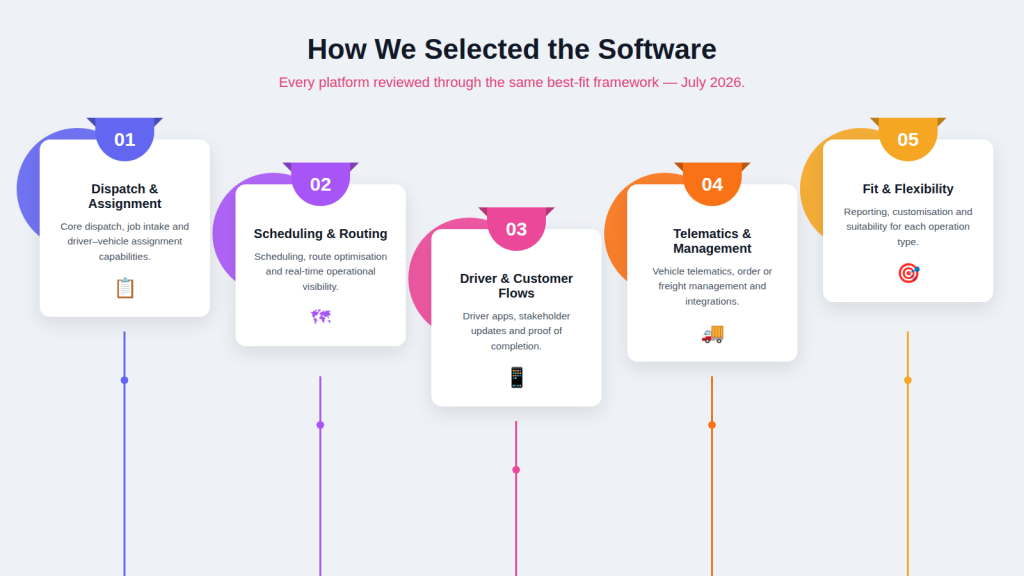
The products are not presented as a universal one-to-ten ranking; the purpose is to explain where each platform is most relevant. AllRide Apps develops transportation and delivery software and is included in this comparison. Every product is reviewed through the same best-fit framework.
What is transportation dispatch software?
Transportation dispatch software is a system that helps an operator coordinate jobs, drivers, vehicles, routes and operational updates from one place. A typical dispatch workflow runs from job intake to completion.
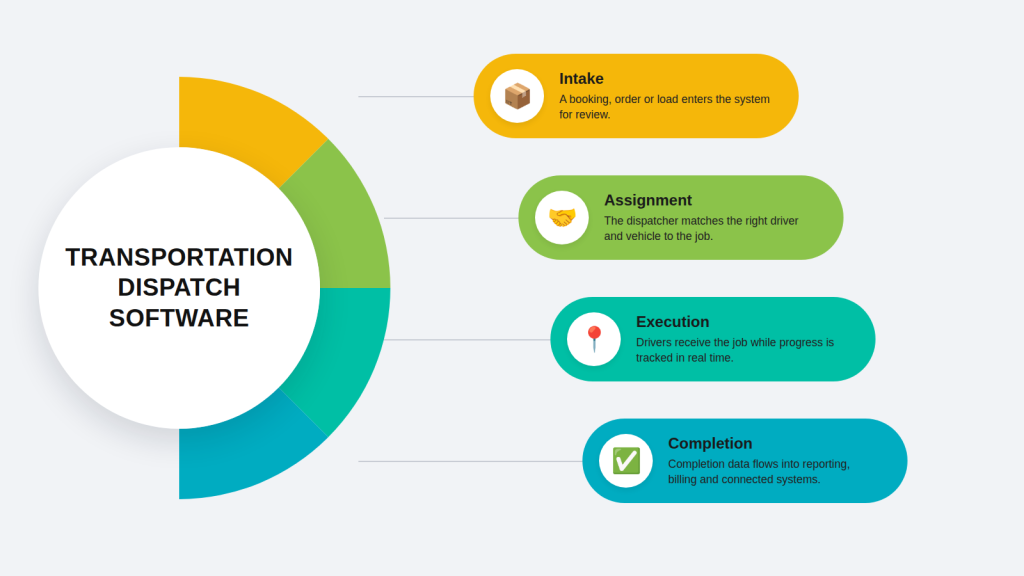
A booking, order, load or service job enters the system; the dispatcher reviews the requirements; a suitable driver and vehicle are selected; the work is scheduled or dispatched; the driver receives the assignment; the operator monitors progress; changes or exceptions are communicated; and completion data enters reporting, billing or another connected system.
Depending on the product, the platform may also provide automated assignment, route optimisation, customer notifications, driver applications, proof of delivery, vehicle telematics, compliance tools, payment processing, booking interfaces, or carrier-network management.
Dispatch software vs route-planning software
Route-planning software determines the order in which stops should be visited. Dispatch software manages a broader execution process, including job assignment, driver availability, vehicle selection, status updates, communication, tracking, and exception handling. Many route-planning products now include dispatch features, but buyers should confirm how deeply they support live operations.
Dispatch software vs fleet-management software
Fleet-management software focuses on vehicles, assets and drivers — GPS tracking, fuel, maintenance, safety, driver behaviour, asset utilisation, and regulatory compliance. Some fleet-management platforms also provide routing and dispatch; others require an integrated routing product.
Dispatch software vs a transportation management system
A transportation management system generally covers a broader freight lifecycle, such as transport planning, carrier selection, rate management, tendering, shipment execution, freight audit, invoicing, and settlement. A TMS may contain dispatch functionality, but it is usually designed for more extensive freight-management requirements.
Transportation dispatch software comparison
This table is organised by best fit, not ranked one to ten. AllRide appears first because this guide is published by AllRide; it is not a claim that it beats the others for every operation.
| Software | Best suited for | Primary strength | Important fit consideration |
| AllRide Apps | Multi-service transport, passenger, logistics and delivery operations | Configurable platform and branded modules | Validate the required module and custom workflow |
| Samsara | Connected commercial fleets | Telematics, safety and route execution | Broader hardware and platform implementation |
| Motive | Trucking and physical-operations fleets | Dispatch connected to tracking and driver compliance | Best fit where fleet operations are central |
| Geotab | Light-duty and data-led fleets | Telematics-led routing and optimisation | Some functionality may involve marketplace solutions |
| Route4Me | Complex multi-stop transport and delivery | Route planning and optimisation | Confirm broader order and finance workflows |
| Onfleet | Last-mile and on-demand delivery | Delivery execution and driver workflow | Primarily delivery-focused |
| OptimoRoute | Delivery and field-service scheduling | Constraint-based planning | Less focused on passenger booking |
| WorkWave RouteManager | Recurring delivery and distribution | Route planning and daily dispatch | Confirm requirements outside route-based delivery |
| Descartes Route Planner | Enterprise distribution and private fleets | Advanced planning and route execution | May exceed the needs of a simple fleet |
| Transporeon | Shippers, carriers and freight forwarders | Freight execution and network visibility | Not designed as a local passenger-dispatch application |
1. AllRide Apps
Best for: Operators that need configurable dispatch across passenger transportation, logistics, delivery or multiple service models.
AllRide provides separate product families for cab and passenger transportation, bus and shuttle operations, logistics, and delivery. Its logistics product describes a dispatch panel, shipment tracking, order management, vehicle management, driver management, operator management and route optimisation. The platform also promotes more than 100 integrations and support for more than 50 languages.
Notable strengths: configurable transport and delivery modules; dispatch and driver-management workflows; order and fleet management; real-time shipment and driver tracking; route optimisation; multiple operator management; integration marketplace; international and multi-language potential; custom branding and application options.
Where AllRide fits. AllRide is particularly relevant when the operation cannot be represented by a single generic delivery route — for example, a taxi company that also runs airport transfers, a shuttle operator managing recurring and private trips, a logistics company that needs order and vehicle management, a transport company launching branded driver and customer applications, or a group planning to expand into several transportation services.
What to validate: which AllRide product module supports the workflow; which functions are included in the selected package; the required integrations; customisation scope; implementation timeline; and any app-store or migration requirements.
2. Samsara
Best for: Commercial fleets that want routing and dispatch connected to telematics, safety and vehicle data.
Samsara’s routing and dispatch offering connects route planning, dispatch, real-time route execution and commercial navigation. Its wider platform includes GPS fleet tracking, safety products, maintenance, asset tracking and compliance capabilities.
Notable strengths: route planning and execution; live vehicle and route visibility; dispatcher-to-driver route updates; commercial navigation; vehicle telematics; safety and driver data; maintenance and asset functions; connected operational reporting.
Where Samsara fits. Samsara is relevant to fleets that see dispatch as part of a larger connected-vehicle strategy, using one platform to analyse vehicle location, route progress, safety events and operational performance rather than combining separate telematics and routing systems.
What to validate: hardware requirements; contract structure; the exact route-planning package; supported integrations; regional compliance requirements; and the total per-vehicle deployment cost.
3. Motive
Best for: Trucking, delivery and service fleets that need dispatch connected to driver, vehicle and compliance workflows.
KeepTruckin changed its name to Motive in 2022. The Motive Dispatch product supports job creation, order imports, route building, driver and vehicle assignment, live dispatch tracking, external tracking links and driver stop workflows.
Notable strengths: job and order creation; bulk CSV imports; route planning and optimisation; driver and vehicle assignment; live job and stop status; driver notes, photos and signatures; customer tracking links; a connected driver application; and a fleet tracking and compliance ecosystem.
Where Motive fits. Motive is relevant where dispatch is closely connected to commercial fleet operation — for example, a trucking or service fleet that wants drivers to manage assignments, inspection activity, compliance and communication through the same application.
What to validate: routing depth; supported order types; document workflow; telematics hardware; compliance coverage; contract terms; and integration requirements.
4. Geotab
Best for: Light-duty or connected fleets that want routing and real-time dispatch based on telematics data.
Geotab offers routing and optimisation tools alongside real-time fleet dispatching through MyGeotab. Its product information describes multi-resource routing, appointment scheduling, route adjustment, live asset visibility and dispatching new jobs, locations, zones or routes.
Notable strengths: live fleet and asset information; route planning and optimisation; real-time job dispatch; multi-resource routing; workload balancing; planned-versus-actual reporting; telematics data; and an extensive partner marketplace.
Where Geotab fits. Geotab is relevant to operations that want dispatch decisions to use existing fleet and asset data — particularly when the business already uses telematics, routes change during the day, dispatchers need to locate the nearest suitable resource, or the operator wants marketplace options around its core fleet platform.
What to validate: whether the required routing functionality is native, provided through an add-in, or dependent on a marketplace partner; plus vehicle compatibility and regional availability.
5. Route4Me
Best for: Businesses with complex, high-volume or frequently changing multi-stop routes.
Route4Me positions its platform around industrial-grade route planning and last-mile transportation, supporting route planning, dispatch and tracking, recurring schedules, driver mobile routing and customer notifications.
Notable strengths: large multi-stop route planning; dynamic route optimisation; recurring route schedules; route dispatch to mobile devices; driver tracking; customer notifications; configurable platform modules; and a last-mile workflow focus.
Where Route4Me fits. Route4Me can suit operations where route complexity is the primary bottleneck — distribution, field sales, service visits, collection routes, recurring deliveries, and multi-stop transportation.
What to validate: whether the selected configuration includes order management, proof of delivery, customer communication, driver workflows, integration APIs, and the required optimisation constraints.
6. Onfleet
Best for: Last-mile delivery operations managing scheduled, on-demand or hybrid fleets.
Onfleet combines route planning, automated dispatch, live driver tracking, customer communication, proof of delivery and delivery analytics, and also promotes hybrid fleet assignment and API integrations.
Notable strengths: automated delivery dispatch; route optimisation; on-demand order insertion; a driver application; live delivery tracking; predictive ETAs; customer updates; photo, signature and barcode proof; delivery performance analytics; and API and commerce integrations.
Where Onfleet fits. Onfleet is designed around the final-mile delivery lifecycle — retailers, couriers, food and grocery operators, pharmacies, prepared-meal companies, and businesses combining internal drivers with external delivery partners.
What to validate. Passenger transportation operators should confirm whether delivery-oriented task and proof-of-delivery structures can support their use case, and businesses should verify route-planning limits and plan-specific features.
7. OptimoRoute
Best for: Delivery and field-service businesses that need constraint-based route and schedule planning.
OptimoRoute plans routes and schedules using factors such as driver hours, breaks, time windows, vehicle capacity, skills and vehicle characteristics, and also provides a driver application, live tracking, customer notifications and proof of delivery.
Notable strengths: automated route and schedule planning; multi-driver optimisation; time-window support; driver skills and vehicle constraints; workload balancing; a driver application; live progress and ETAs; customer notifications; and proof of delivery.
Where OptimoRoute fits. OptimoRoute is relevant when both routing and scheduling constraints determine who should perform the work — delivery operations, equipment installation, inspection services, maintenance visits, and commercial field logistics.
What to validate: support for on-demand insertion, multi-day planning, commercial truck routing, integrations, custom driver workflows, and operation-specific documentation.
8. WorkWave RouteManager
Best for: Recurring distribution, courier and route-based delivery businesses.
RouteManager by WorkWave focuses on planning, scheduling and dispatching routes to drivers’ mobile devices, positioned for delivery, courier, logistics, distribution and field-service operations.
Notable strengths: route planning; route scheduling; daily mobile dispatch; driver tracking; workload distribution; recurring delivery operations; courier and distribution workflows; and operational reporting.
Where WorkWave fits. RouteManager may be relevant for businesses that operate repeatable route structures but still need to adjust schedules, distribute stops and communicate daily routes to drivers.
What to validate: dynamic same-day changes; proof-of-delivery options; customer notifications; telematics integrations; vehicle constraints; and financial-system integrations.
9. Descartes Route Planner
Best for: Enterprise distribution, private fleets and complex delivery operations.
Descartes Route Planner covers route planning, optimisation and route execution. Its product family includes dynamic and static routes, dispatch, real-time progress tracking, proof of delivery and advanced delivery-scheduling capabilities.
Notable strengths: enterprise route planning; static and dynamic routing; delivery appointment scheduling; real-time route execution; a driver mobile application; proof of delivery; exception communication; order integration; and large-scale operational support.
Where Descartes fits. Descartes is relevant to larger distribution businesses whose route plans must balance delivery windows, capacity, customer priorities, fixed route patterns, dynamic orders, and enterprise-system integrations.
What to validate: implementation complexity; licensing model; integration scope; internal planning resources; and whether the platform is proportionate to the operation’s size.
10. Transporeon
Best for: Shippers, carriers, suppliers and freight forwarders coordinating transportation across a network.
Transporeon’s platform focuses on freight procurement, transport execution, visibility, dock and yard management, and freight audit. Its execution products bring together transport assignment, shipment execution and real-time visibility across connected organisations.
Notable strengths: freight assignment; carrier and shipper collaboration; transport execution; real-time shipment visibility; ETA information; multimodal transportation workflows; dock and yard coordination; freight audit capabilities; and a connected freight network.
Where Transporeon fits. Transporeon is best understood as a freight-network and transport-execution platform rather than a local taxi, shuttle or delivery-driver dispatch application. It can suit organisations coordinating multiple carriers, cross-company transport orders, large freight networks, inbound and outbound logistics, or complex shipment visibility.
What to validate: supported transport modes; carrier-network coverage; connection methods; tendering requirements; visibility data sources; and integration with the existing TMS or ERP.
This table is a starting point rather than a final purchasing recommendation.
What features should transportation dispatch software have?
A complete dispatch platform should handle job intake, driver and vehicle assignment, scheduled and dynamic dispatch, route optimisation, real-time tracking and exceptions, a capable driver app, customer visibility, reporting, and integrations.
Job, booking or order management. The platform should accurately capture the work to be performed — a passenger booking, a pickup and delivery, a freight load, a field-service job, a recurring route, or an on-demand request.
Driver and vehicle assignment. The software should help the dispatcher identify eligible resources using availability, location, vehicle type, capacity, shift, skill, route, and service area.
Scheduled and dynamic dispatch. Test how the system handles urgent jobs, driver absence, vehicle breakdown, new orders, route delay, cancellation, and reassignment.
Route optimisation. The routing engine should support the constraints that actually affect the operation — time windows, driver hours, vehicle capacity and dimensions, service time, depot location, pickup and drop-off sequence, recurring stops, and restricted areas.
Real-time tracking and exceptions. A map alone is not sufficient; dispatchers need to see which jobs are unassigned, which drivers are late, which stops were missed, which route is at risk, the latest ETA, and which exception requires action.
Driver application. The driver app should make execution easier, not merely display a route. Test assignment acceptance, stop details, navigation, status updates, messaging, document capture, photo or signature evidence, offline behaviour, and end-of-job completion.
Customer or stakeholder visibility. Relevant capabilities include live tracking links, ETA messages, delay alerts, booking confirmations, delivery notifications, or customer portals.
Reporting and analytics. Useful metrics include on-time arrival, dispatch response time, route completion, unassigned jobs, planned versus actual distance, idle time, failed deliveries, driver utilisation, customer waiting time, and cost per job.
APIs and integrations. Confirm how the platform exchanges data with booking systems, ERP, CRM, warehouse systems, payment gateways, accounting platforms, telematics, mapping providers, and customer applications.
How much does transportation dispatch software cost?
Transportation dispatch software is priced in many ways — per vehicle, driver, user, order or stop, by module, by telematics hardware, or on enterprise contract terms — so never compare subscription prices alone. Total cost of ownership is the real number.
Beyond the subscription, total cost of ownership can include setup and configuration, migration, hardware, training, integration development, app publication, ongoing support, data storage, additional locations, API fees, custom reports, and contract-termination requirements. Ask each vendor for a written cost breakdown based on your actual fleet and transaction volume.
Questions to ask during a dispatch software demo
- Can the system reproduce our current dispatch workflow?
- Does it support scheduled and on-demand jobs?
- How are drivers and vehicles selected?
- Can dispatchers override automated assignments?
- Which route constraints are supported?
- What happens when a driver rejects or misses an assignment?
- Can an active route be changed without recreating it?
- How are customers informed of delays?
- What does the driver see before accepting a job?
- Can the driver capture photos, signatures or documents?
- Does the application work with weak connectivity?
- Can the system support multiple depots or operators?
- Which functions require additional modules?
- Which integrations are native?
- What API access is included?
- Can historical data be migrated?
- Can all operational data be exported?
- What reporting is available without custom development?
- What are the implementation and training requirements?
- What is the complete first-year and three-year cost?
Use actual routes, drivers, constraints and exceptions during the demonstration. A polished vendor presentation is not a substitute for a realistic workflow test.
How AllRide supports multi-service transportation operations
Many transportation companies operate more than one service type. A business may begin with local deliveries and later add scheduled transportation; a passenger operator may run taxis, airport transfers, corporate routes and shared shuttles; a logistics organisation may require fleet, driver, order and operator management in the same environment.
AllRide offers separate cab, bus, logistics and delivery product families. Its logistics platform includes dispatch, order management, driver management, vehicle management, operator management, shipment tracking and route optimisation, supported by an integration marketplace. This makes AllRide most relevant when the buyer needs configurable transport workflows, branded driver or customer applications, more than one service model, internationalisation, system integrations, or a platform that can be adapted as the operation expands.
The exact package, configuration and implementation plan should be verified through a requirements-based demonstration.
Evaluating transportation dispatch software? See how AllRide can connect bookings or orders, dispatch, drivers, vehicles, tracking and reporting through a configurable transportation platform. Book a personalised demo.
Frequently asked questions
What is transportation dispatch software?
Transportation dispatch software helps operators schedule jobs, assign drivers and vehicles, plan routes, monitor execution and communicate updates through a central system.
Is dispatch software the same as route-planning software?
No. Route planning determines stop order and route structure. Dispatch software also manages assignments, statuses, communication and live operational changes.
Is dispatch software the same as fleet-management software?
Not always. Fleet-management software focuses on vehicles, drivers, tracking, safety and maintenance. Some fleet platforms include dispatch, while others connect to separate dispatch tools.
Does transportation dispatch software include GPS tracking?
Many platforms include GPS tracking or integrate with a telematics provider. Buyers should confirm tracking frequency, hardware requirements and historical-data access.
Can a small transportation company use dispatch software?
Yes. Small companies may benefit when they manage several drivers, repeated schedules, cash-sensitive operations or frequent customer status inquiries. The required product depth depends on operational complexity.
Can dispatch software manage scheduled and on-demand work?
Some platforms support both. During the demo, test how an urgent request is inserted into existing assignments and how the change reaches the driver.
Which dispatch software is best for last-mile delivery?
Onfleet, Route4Me, OptimoRoute, WorkWave and Descartes are all relevant options, but they differ in routing depth, driver workflow, enterprise scale and integration requirements.
Which dispatch software is suitable for multi-service transportation?
A configurable platform such as AllRide may be relevant when an operator needs to manage several passenger, logistics or delivery workflows through related modules.
Does dispatch software reduce fuel use?
Route optimisation and better vehicle utilisation can reduce unnecessary mileage, but results depend on route quality, operating conditions, driver behaviour and implementation. No vendor should guarantee a specific saving without analysing the operation.
What should I test before buying dispatch software?
Test job creation, assignment, route changes, driver acceptance, tracking, customer updates, proof of completion, reporting, integrations, weak connectivity and exception handling.